
How to choose an interpreter for international business negotiations
Editorial illustration
GURI Journal · Published 31 October 2026
An interpreter can sound fluent while the meeting still leaves the companies with different understandings of a condition. The difficult part of a business discussion is often a qualifier, a unit, a technical term or the distinction between considering an option and accepting it. Choosing support therefore requires more than checking whether someone speaks both languages confidently.
GURI starts with the discussion itself: who will attend, what they need to understand and what decisions the meeting may advance. That description helps define the language service. It also keeps interpreting separate from commercial representation, engineering judgment and legal advice. If one professional is expected to perform additional roles, those roles need to be agreed and assessed explicitly.
Define the language assignment
State the languages and directions required. Do not assume that listing several languages on a profile means the interpreter works equally in every direction. Identify any participant who will use a third language and explain how their contribution is expected to reach the rest of the group. The communication route should be clear before the meeting starts.
Describe the format: a bilateral discussion, a presentation followed by questions, a site visit or a hybrid meeting with remote specialists. Mention the duration, parallel conversations, movement between locations and any recordings or videos. The same language pair can require a different working arrangement when the structure of the event changes.
The professional association AIIC Asia-Pacific explains that staffing depends on the languages, interpreting mode, meeting length and parallel sessions. Use that as a reason to define the assignment properly, rather than assuming one staffing arrangement suits every negotiation.
Assess preparation for the subject
Describe the product, process and difficult questions. Relevant experience is useful when it helps the interpreter understand what is being discussed and prepare the terminology. A general claim of business experience says less than a clear explanation of how they would prepare for your particular subject and deal with unfamiliar terms.
Ask for appropriate evidence of experience without requesting another client's confidential documents. A discussion of assignment types, responsibilities and preparation methods can be informative. If a sample exercise is needed, agree its scope and commercial terms. It should test a relevant capability without turning selection into an unlimited unpaid assignment.
Explore how the interpreter handles ambiguity. A request for clarification can prevent a serious misunderstanding. An assurance that clarification is never necessary should not be treated as a quality guarantee. The objective is to preserve meaning, including uncertainty and qualifications, rather than to make every sentence sound more definite than the speaker intended.
Prepare a useful briefing pack
Provide the current agenda, participant roles, product references, relevant presentations and a terminology list. Flag the conditions that have caused disagreement and the document versions that remain open. An internal abbreviation may be obvious to your employees and entirely opaque to someone outside the company, even if they know the industry well.
Separate background information from material that will be shown or distributed. The interpreter needs to know which version participants are discussing. If a file changes, identify the revision and the affected points. Sending several similar documents without explaining their status can create avoidable uncertainty during a fast conversation.
Brief the team on confidentiality and permitted handling of materials. Agree who may receive the documents and what processing methods are acceptable. Do not assume that recording, automated transcription or uploading the contents to an external service is covered by a general request to provide interpretation. The arrangement should reflect the information and people involved.
Keep the role boundaries visible
A language professional should not become the person who grants a commercial concession merely because they are the easiest participant for the counterpart to address. Name the people who lead the negotiation and make decisions. If the interpreter is also expected to coordinate visits or explain a technical process, clarify the scope, competence and potential conflicts in that arrangement.
Likewise, detailed minutes should not be assumed to appear automatically alongside continuous interpreting. Decide who records the discussion and who checks the summary. The interpreter may help clarify a disputed expression, but responsibility for the business conclusion should remain with the appropriate members of the team.
In a hypothetical equipment discussion, an interpreter can accurately convey an engineer's explanation of a tolerance. That does not establish that the tolerance is suitable for the buyer's application. The technical specialist must assess suitability, while the commercial team decides what the condition means for the proposal. Keeping those tasks distinct makes the conversation easier to manage.
Agree the working conditions and price basis
Compare quotations against the same assignment. Identify preparation, time at the venue, waiting, travel, additional hours and the handling of changes. If written translation is needed during or after the meeting, list it separately. A request to translate a document during a break may remove the break on which the original working arrangement depended.
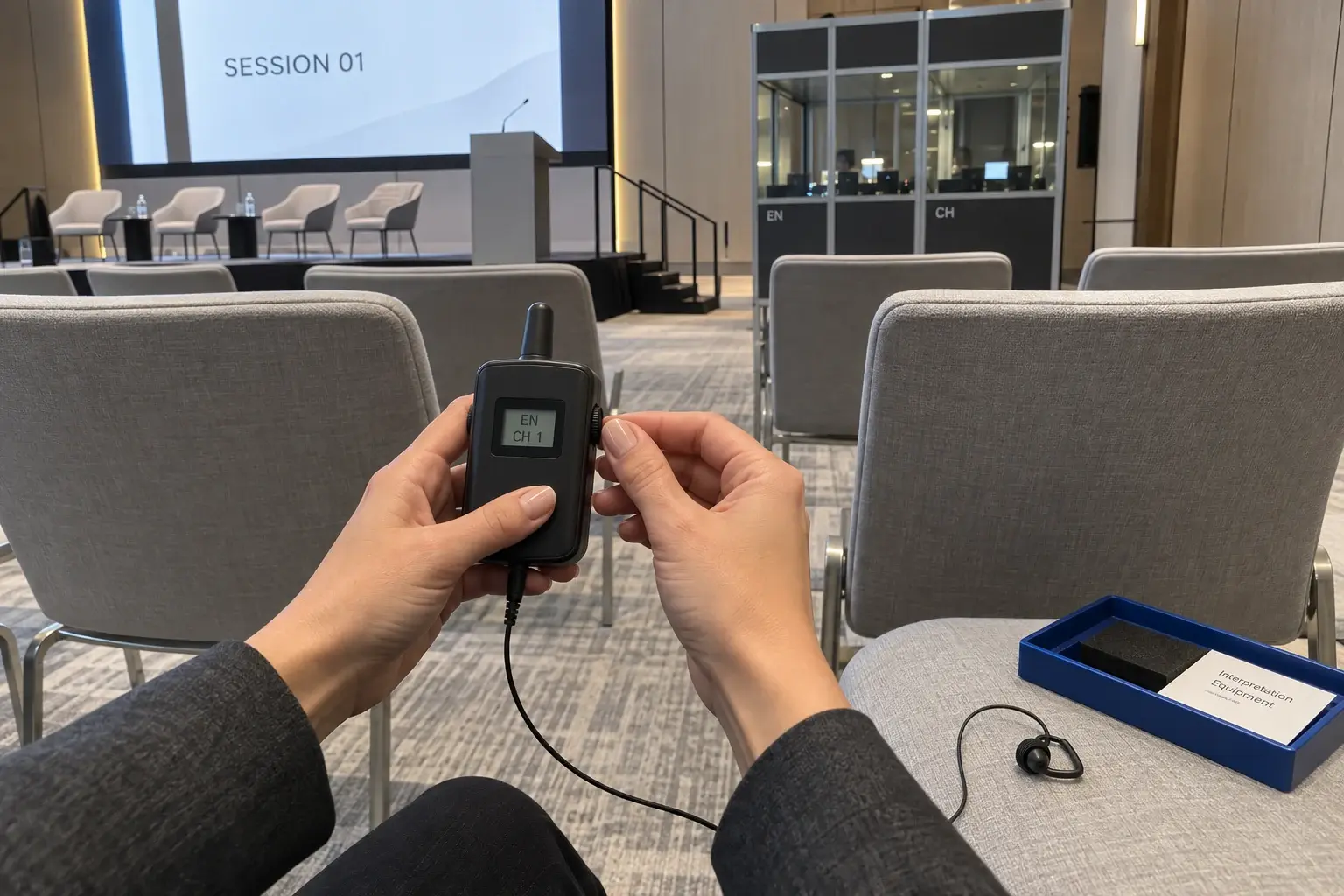
Clarify who provides the equipment and technical support. In a remote meeting, good language skills cannot compensate for speech that is inaudible or repeatedly cut off. Test the actual arrangement and agree how the interpreter can signal a problem. Participants should know when the substantive discussion needs to pause so that everyone can understand the same exchange.
Discuss changes and cancellation before confirming the assignment. The applicable conditions should be stated in the agreement rather than inferred from general industry practice. If the meeting becomes longer, adds languages or splits into parallel sessions, reassess the resources instead of treating the original booking as covering every subsequent version of the programme.
Help the interpreter deliver accurate communication
Use manageable turns, identify units and document versions, and avoid several people speaking at once. Address the counterpart directly while allowing time for the interpretation. When a condition changes, make the change explicit. A rushed correction buried in a long sentence can be more consequential than a minor stylistic imperfection.
At the close, check the important figures, qualifications and next actions with the relevant participants. Distinguish what was proposed from what was confirmed and what still needs review. The goal is a usable shared understanding of the discussion. Smooth delivery helps, but it should never be the only evidence used to judge whether the companies have understood the same terms.