
Garment inspection in China: a practical checklist before shipment
Editorial illustration
GURI Journal · Published 30 October 2026
A finished garment can look convincing on a hanger and still fail the order. Measurements may be wrong, shades may vary between panels, or the size label may not match the item inside the bag. An inspection becomes useful when it tests the actual purchasing requirements, rather than simply producing photographs of attractive samples.
GURI's starting point is the approved product version. The inspector needs the technical pack, measurement method, tolerances, material references and packaging instructions that the factory was expected to follow. Without those references, both parties are left debating what “good quality” means.
Decide which production stage needs attention
Pre-shipment inspection is only one opportunity to find problems. Intertek's apparel inspection service describes checks before production, during manufacture and before delivery. The appropriate stage depends on where an error would become costly to correct.
For a new pattern or unfamiliar fabric, waiting until all garments are packed may be too late to address a systematic issue efficiently. An earlier review can examine the first production output and whether the agreed methods are being followed. It does not remove the need to check the completed shipment.
Write down what each visit should establish. A progress check, a workmanship inspection and laboratory testing answer different questions. Booking one service does not automatically cover all three.
Make the order available for a meaningful check
Confirm the production and packing status before the visit. The inspector must be able to identify the order, access relevant cartons and select items according to the agreed plan. A presentation of specially prepared pieces is not equivalent to checking the production lot.
Provide the assortment by style, colour and size, together with carton information where available. If part of the order is missing or unfinished, the report should state the limitation. Avoid treating an incomplete inspection as approval of goods that were never available.
Agree how sampling will work and how findings will be assessed. Sampling has limits: it provides evidence about selected items under a defined plan, not a promise that every garment is defect-free. Where a particular risk requires broader checking, discuss that explicitly.
Check measurements using the same method
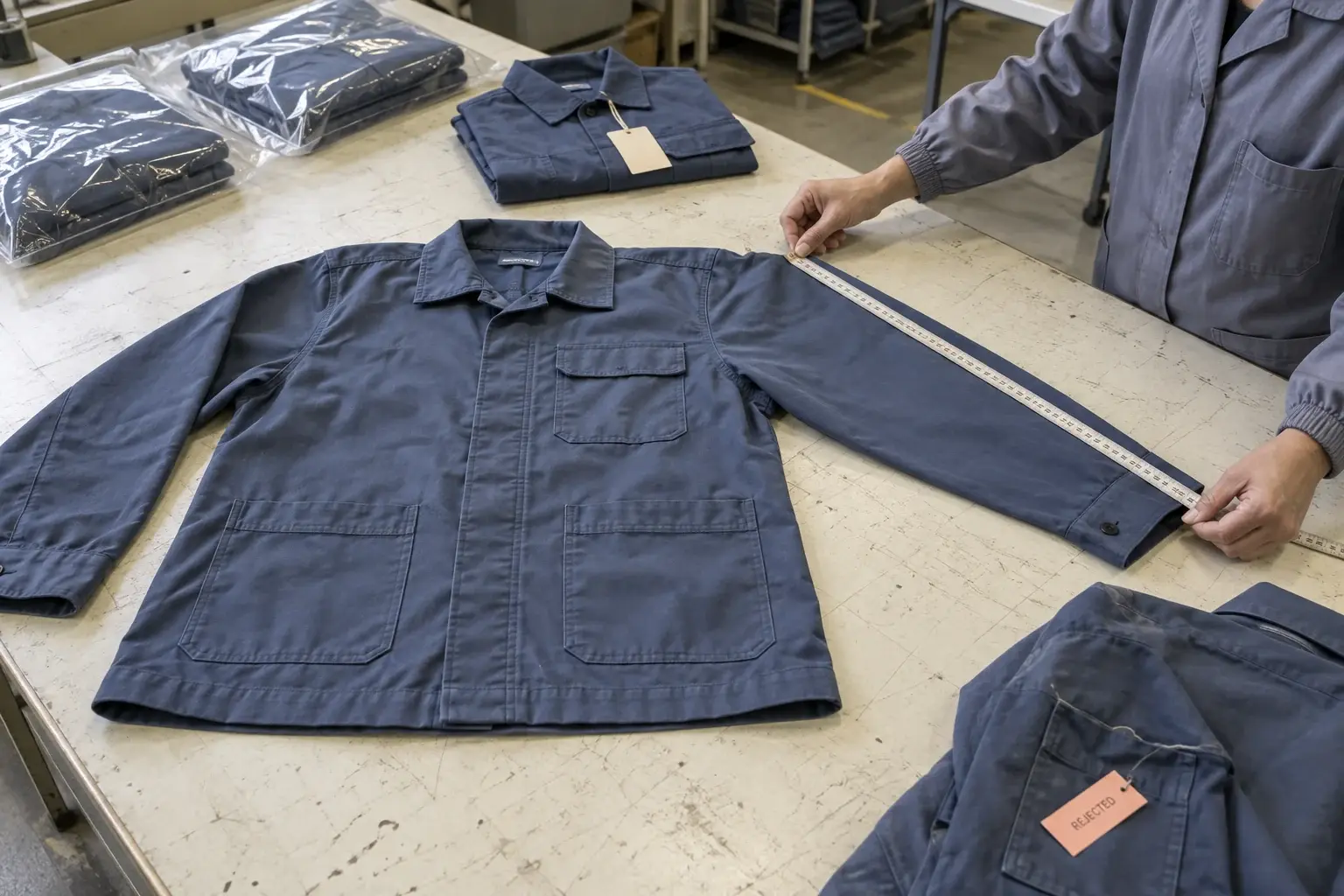
Measurements should refer to defined points on the garment. The instructions need to explain positioning, fastening and any relevant conditioning. Stretching a knit garment during measurement can produce a different result from laying it flat without tension.
Review more than the nominal size label. Compare key dimensions against the approved table and examine the progression between sizes. A correct middle-size sample does not establish that the smallest and largest sizes have been graded correctly.
When a measurement is outside tolerance, record the actual value and method. A photograph showing the tape helps only if the starting point and garment position are clear. Otherwise the factory may be unable to reproduce the result or identify the cause.
Look at construction, materials and appearance together
Check seams, stitching, hems, closures, attachments and finishing against the specification. The consequence matters: a loose decorative thread and a weak load-bearing seam should not be treated as interchangeable observations. Define defect categories before the inspection wherever possible.
Assess fabric and shade consistency within a garment and across the sampled assortment. A colour reference should be identifiable, and the viewing conditions should support a fair comparison. Screen photographs alone are a poor basis for resolving subtle shade differences.
Test the agreed functions, such as opening and closing fasteners, without turning an informal check into an unsupported performance claim. Chemical composition, restricted substances and some durability properties may require appropriate laboratory methods. Visual inspection cannot establish everything about the material.
Match the garment to its labels and packaging
Compare the sewn label, hangtag, bag and carton information with the item. A perfectly printed label attached to the wrong size is still a fulfilment problem. Check style and colour identifiers as well as the size.
Inspect the approved folding or hanging method and protection for vulnerable details. Embellishments, sharp trim and wet or insufficiently dried garments can create problems after packing. The chosen protection should be appropriate to the product and the planned handling conditions.
Destination-market labelling and product requirements need their own review. An inspector can check against an approved artwork, but that does not automatically establish that the artwork meets every applicable rule. Assign responsibility for the underlying information before printing.
Turn findings into a decision and a correction plan
A useful report links each finding to a style, colour, size, quantity or sampled item, with photographs and the relevant requirement. It should also identify access limitations and unperformed checks. A simple “passed” label without that context may hide unresolved questions.
Agree who decides whether to release, sort, repair or reinspect the goods. If corrections are required, state their scope and how completion will be verified. A factory's photograph of one repaired piece does not establish that the entire affected group has been addressed.
Consider whether the repair introduces another problem. Restitching can leave marks, stain removal can affect colour, and replacing a label can create new mix-ups. The follow-up check should cover both the original issue and plausible consequences of the proposed fix.
Keep the report with the approved product documents and use recurring findings to improve the next order. Inspection is most valuable when it changes the process: a grading error should lead to a corrected size specification, while shade variation may require better material-lot control. Repeating the same final check without addressing the cause leaves the next shipment exposed to the same problem.