
International sales contract review: follow the transaction from order to acceptance
Editorial illustration
GURI Journal · Published 31 October 2026
A cross-border sales contract can contain familiar headings and still be difficult to execute. Payment, shipment and inspection clauses may each sound reasonable while requiring events to occur in an impossible order. A careful review therefore begins with the transaction as a whole, before moving to individual wording.
GURI uses a practical question: could a colleague who did not attend the negotiations carry out the next steps using this document set? If the answer depends on an unwritten understanding, the reviewer has found something worth clarifying. The aim is to turn uncertainty into a specific decision, supported by the relevant facts.
Establish what you are actually reviewing
Collect the current main agreement, specifications, schedules and referenced attachments. Record their versions and identify the commercial terms that have already been discussed. Keep the other party's latest changes visible. A review of an old attachment can be internally accurate and still miss the agreement now being proposed.
Create a short list of missing documents. If the contract refers to a quality schedule that has not been supplied, its contents remain unknown. Do not infer that it will contain your preferred inspection process. The missing attachment is a substantive review issue whenever an obligation depends on it.
Confirm the intended legal parties and map any separate manufacturer, exporter, consignee or payment recipient. A complex arrangement needs explanation and appropriate evidence; complexity alone does not prove wrongdoing. The reviewer should understand which entity undertakes each obligation and which questions require further verification.
Walk through the normal performance sequence
Start at the first action after agreement and follow the order through production or allocation, payment, inspection, dispatch, arrival and acceptance. At each stage ask who acts, what starts the deadline and what information the other party receives. Read linked provisions together rather than treating every clause as an isolated item.
Consider a hypothetical order in which the balance is payable after inspection at the buyer's premises, while the supplier will ship only after full payment. That sequence cannot work as written without an additional arrangement. The useful review comment identifies the conflict, explains its consequence and sends the commercial choice to the people authorised to resolve it.
Check dependencies on the buyer too. A production period may assume timely approval of a drawing, colour or component. If the buyer takes longer, the document should give the team a way to understand the effect on the schedule. The precise legal mechanism needs appropriate advice, but the underlying operational dependency should be explicit.
Compare the specification with every commercial reference
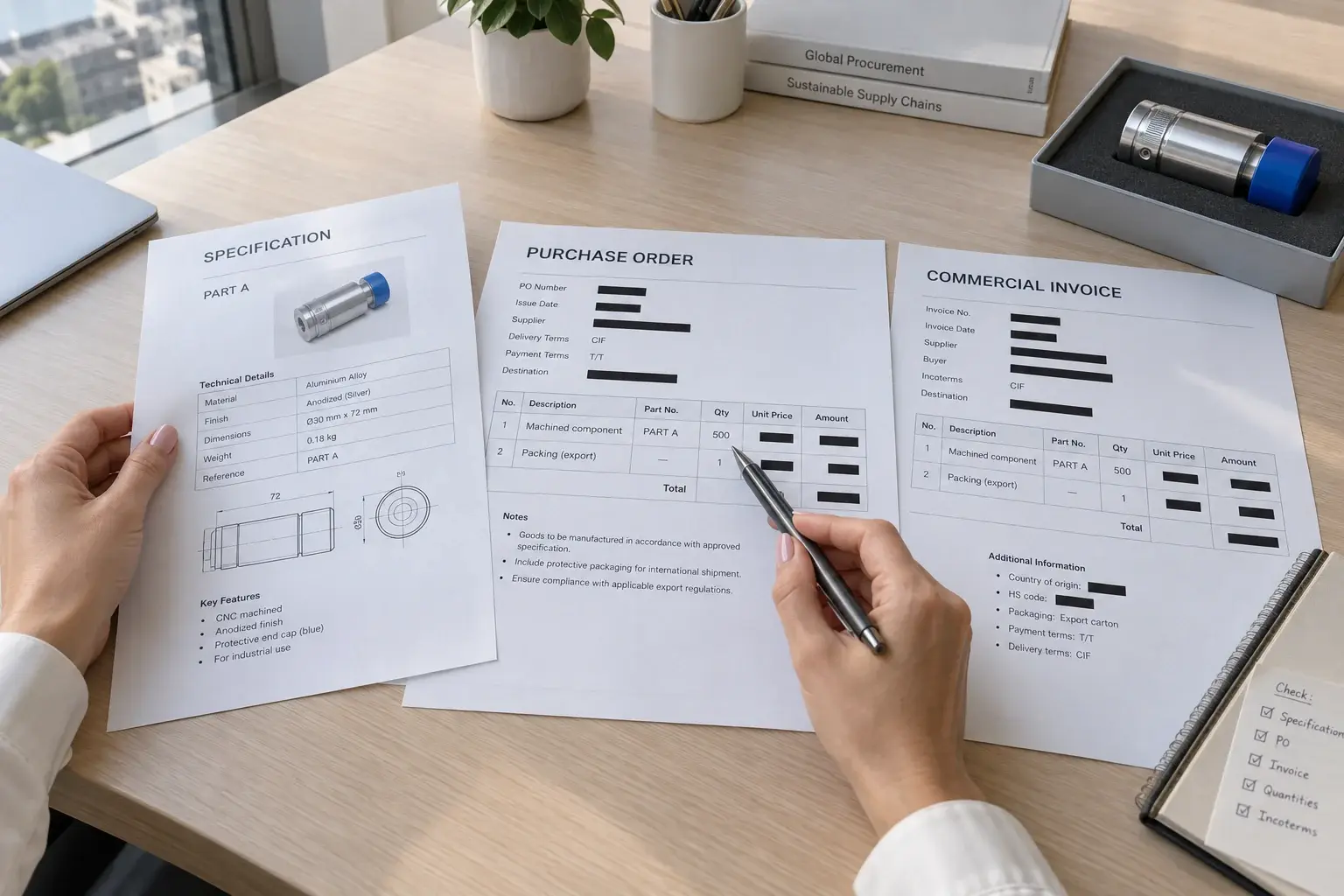
Match models, quantities, units, accessories and packaging across the agreement, specification and quotation. Recalculate totals. Look for services that were included in the offer but disappeared from the contract, or costs that appear twice under different descriptions. These checks complement legal analysis rather than replacing it.
For important product properties, examine how the parties will determine conformity. Identify the relevant drawing, sample or defined specification and the proposed checking method. A statement that quality will be satisfactory may leave the buyer and seller with different expectations about the evidence needed.
Use destination-market requirements carefully. The review needs a current assessment for the particular product and route, not a certificate borrowed from another transaction. Assign unresolved technical or regulatory questions to an appropriate specialist and record what the contract drafter needs from that assessment.
Test one realistic deviation
Choose a problem that could materially affect this order: incomplete quantities, an incorrect document, delayed readiness or an issue found during testing. Follow the proposed notification and response process. Who receives the notice? What information is required? Can the person carrying out the process obtain it within the stated period?
Distinguish an external packaging check from a functional test. They may involve different people, locations and opportunities to identify a defect. A short administrative receiving step should not be assumed to answer every question about the goods. Review the contract's treatment of these activities in the context of the product and applicable law.
Look beyond a penalty clause to the business outcome. The buyer may need a replacement component, a corrected document or a workable revised shipment plan. A contractual remedy that sounds strong may not solve the immediate operational problem. The reviewer should explain the gap without promising a particular legal recovery.
Keep the legal framework visible
Governing law, dispute resolution, signing arrangements and authority need analysis for the actual parties and proposed transaction. Do not treat a familiar form as proof that those questions have been settled. Commercial review supplies facts for legal review; it does not remove the need for it.
The official UN text of the CISG distinguishes its scope from matters it does not govern, including contractual validity and the effect on ownership. Whether and how the Convention applies must be assessed for the particular transaction.
Where two language versions are used, compare obligations, exceptions, definitions and notice periods as well as figures. A subtle difference in how a duty is expressed can matter more than a visible spelling error. Translation review and legal review answer different questions, so preserve both sets of comments and resolve their interaction.
Write review comments that someone can act on
Separate data errors, commercial choices and specialist questions. Identify the clause or attachment, describe the issue and state the next action. “Please improve this section” is much less useful than explaining that two documents give different dates and asking the responsible manager which sequence has been agreed.
Prioritise by the next commitment. A missing price basis or unresolved payment recipient may matter before an advance; an incomplete inspection arrangement may become critical before production is released. Prioritisation does not make other issues disappear. It shows why a particular question needs an answer before a particular action.
After revisions, recheck the linked provisions. Moving a shipment date may change inspection availability, document timing and payment assumptions. Save a clean agreed set and a record of significant changes. The result should let management see what has been corrected, what remains uncertain and the conditions under which the company is prepared to proceed.